Drilling · Karachi
Concrete Drilling Services in Karachi
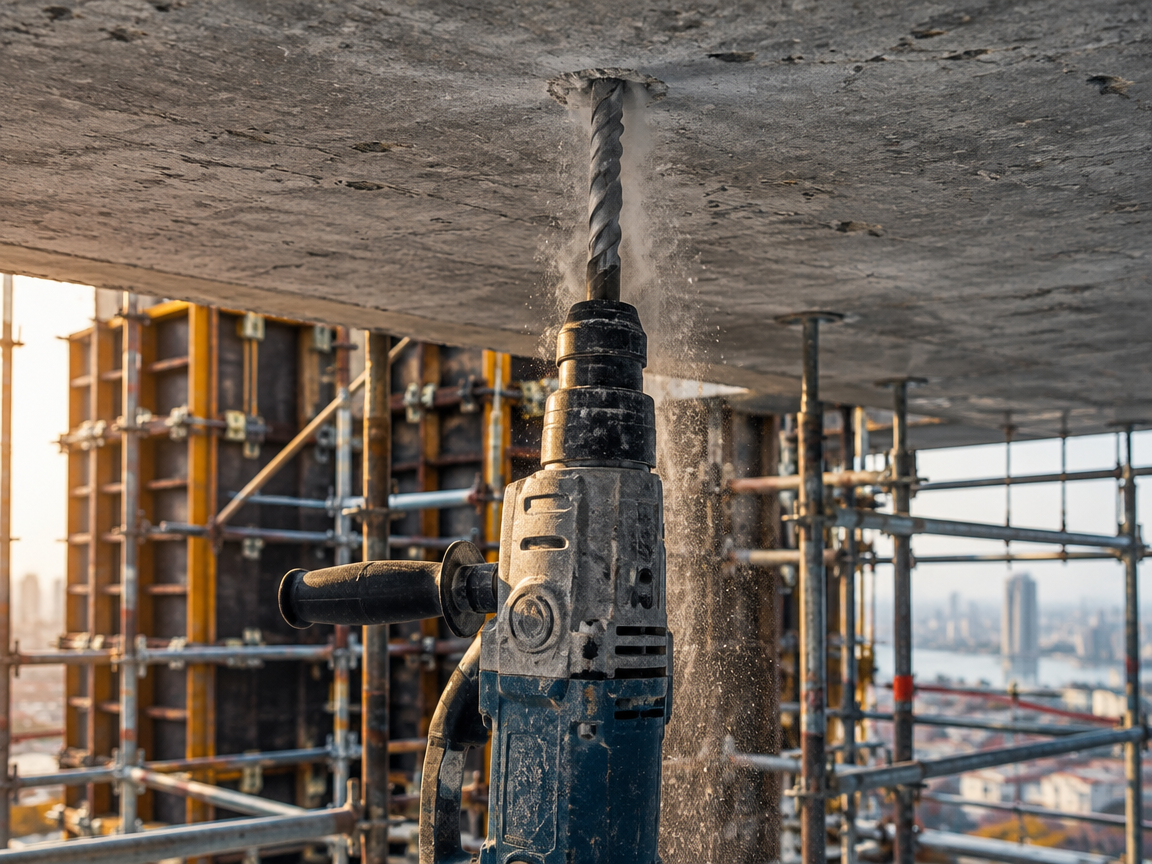
Drilling is the everyday side of concrete work: a hole for an anchor, a fixing, a pipe, a conduit or a grille. It looks simple, and on the right surface with the right machine it is. On the wrong surface — hard aggregate concrete, reinforced concrete, or the underside of a slab that has to be drilled upwards — the same hole can cost a lot of time and drill bits if the method is wrong. This page explains how we drill, what decides the method and what affects the price.
Service specifications
Typical diameters
6 mm to 60 mm (cored holes above this)
Typical depth
Up to 400 mm, depending on the fixing
Surfaces drilled
Floors, slabs, ceilings, walls, columns, plinths
Methods
Rotary hammer drilling, diamond drilling, core drilling
Coverage
Karachi — availability confirmed per project
Concrete drilling explained
A hammer drill breaks the concrete as it turns, which is fast but leaves a rougher hole and can crack the area around it if the tool is pushed too hard or the bit is worn. Diamond drilling grinds the hole, which is slower but leaves a clean, accurate hole with a sound edge — the right choice where a fixing has to take a real load or where the drill has to pass through reinforcement.
Depth control is the part people overlook. For a chemical anchor or a mechanical anchor, the hole has to be drilled to the depth the fixing manufacturer specifies, cleaned out properly, and kept clear of dust. A hole that is 20 mm short will not hold the load it was designed for, and a hole that is full of dust will fail the pull-out test. When we drill for fixings, the manufacturer’s specification is what we work to.
Where drilling is used
- Anchor holes for handrails, railings, gates, signage, canopies and equipment bases
- Fixings for air-conditioner outdoor units, brackets and support frames
- Plumbing and sanitary fixings, pipe supports and clamps
- Electrical conduit saddles, earthing and panel mounting holes
- Ventilation grilles, exhaust fans and small duct fixings
- Holes for chemical anchors, grouting and starter bars in approved positions
- Small-diameter service penetrations where a cored hole is not required
- Test and inspection holes for consultants and site engineers
Choosing the right drilling method
The method follows the material and the size of the hole, not habit. Small holes in standard concrete are handled with a rotary hammer drill, which is quick and cost-effective when the fixing is not heavily loaded. Where a cleaner hole is needed, where the concrete contains hard aggregate, or where the hole passes close to a finished edge, diamond drilling gives a better result with far less vibration.
Larger diameters, holes that pass right through a slab or wall, and holes through reinforced concrete are core-drilled rather than hammer-drilled. Above roughly 60 mm, core drilling is almost always the better option: the hole is round, the size is exact, the finish is clean on both faces, and the concrete around the hole is not shaken.
Whatever method is used, the reinforcement inside the concrete has to be considered. Rebar detection or a review of the drawings is the normal first step for fixing work, because drilling into a main bar weakens the element and ruins the fix. Where a bar is unavoidable, we agree the revised position with you before drilling.
Site access and working conditions
Drilling is usually one of the last trades on site, which means the area around the work needs protecting. Dust is controlled at the bit — a vacuum attachment or water feed, depending on the surface and the finish — and the working area is sheeted before the machine starts.
Working conditions decide how long the job takes. Drilling upwards into a ceiling, drilling at height from a ladder, drilling in a plant room with no space to stand, or drilling in a basement with no power point all add time. Tell us the access conditions when you enquire and the estimate reflects the real job instead of the best case.
Factors affecting the drilling cost
- Hole diameter and depth — both drive the time and the tooling
- Number of holes, and whether they are drilled in a repeated pattern
- Material — standard concrete, hard-aggregate concrete, reinforced concrete, block or brick
- Steel reinforcement encountered in the hole
- Access and working height, including drilling ceilings and confined plant rooms
- Dust control and protection needed for a finished area
- Power and water availability at the working position
- Travel within Karachi and the number of separate visits
Safety precautions we work to
- Protective equipment — eye and ear protection, gloves and dust protection — worn while drilling
- Dust controlled at the source with a vacuum attachment or a water feed
- Electrical tools and extension leads checked, with safe routing for wet cutting work
- Working platforms used for height work, and the machine fixed before it is started
- Rebar positions checked before drilling into structural elements
- Work area sheeted and cleared, with open holes covered or marked until they are filled
Drilling FAQs
Drilling — common questions
If your question is not answered here, call us — the answer usually takes less than a minute.
What is the difference between drilling and core drilling?
Drilling normally means a hammer or rotary drill making smaller holes for fixings and small services. Core drilling uses a hollow diamond bit to cut a larger, rounder hole through a wall or slab and is the correct method for larger diameters and through-penetrations.
How deep can you drill for an anchor?
It depends on the fixing and the element. We follow the anchor manufacturer’s specified diameter and embedment depth, and clean the hole before the fixing goes in. Tell us the anchor type and the load it has to take and we will confirm the hole size.
Can you drill into a ceiling slab upwards?
Yes. Drilling upwards is slower because the drill has to be held and fed against gravity, and the dust falls towards the operator, so dust control is planned first. Access equipment is often required, and the position is checked for reinforcement before drilling.
Will drilling crack the concrete around the hole?
A hammer drill can spall the surface if it is forced or the bit is blunt, which is why the method is matched to the material. Where the concrete is hard, reinforced, or close to a finished edge, diamond drilling is used instead — it cuts cleanly with almost no vibration.
Do you drill into brick and block walls too?
Yes. Block and brick are drilled with the appropriate bit and a lighter feed to avoid breaking out the face of the wall. For heavier fixings in masonry, we will tell you if a different fixing or a resin anchor is a better solution.
Related services
Other work we carry out
Most projects need more than one type of opening. These are the services that usually go with this one.
Round, accurately placed holes through reinforced concrete walls, slabs and beams — cut with diamond core bits and finished clean.
Vertical holes through floor slabs for drainage, plumbing, conduits and services — cut accurately and cleaned out ready for the pipe.
Horizontal and angled openings through concrete, block and masonry walls for pipes, cables and ventilation — cut with the correct tooling.
Request a quotation
Need drilling priced for your site?
Send the diameter, the quantity, the thickness and the project area in Karachi, Sindh. You will get a written scope and a firm quotation.