Wall Core Cutting · Karachi
Wall Core Cutting Services in Karachi
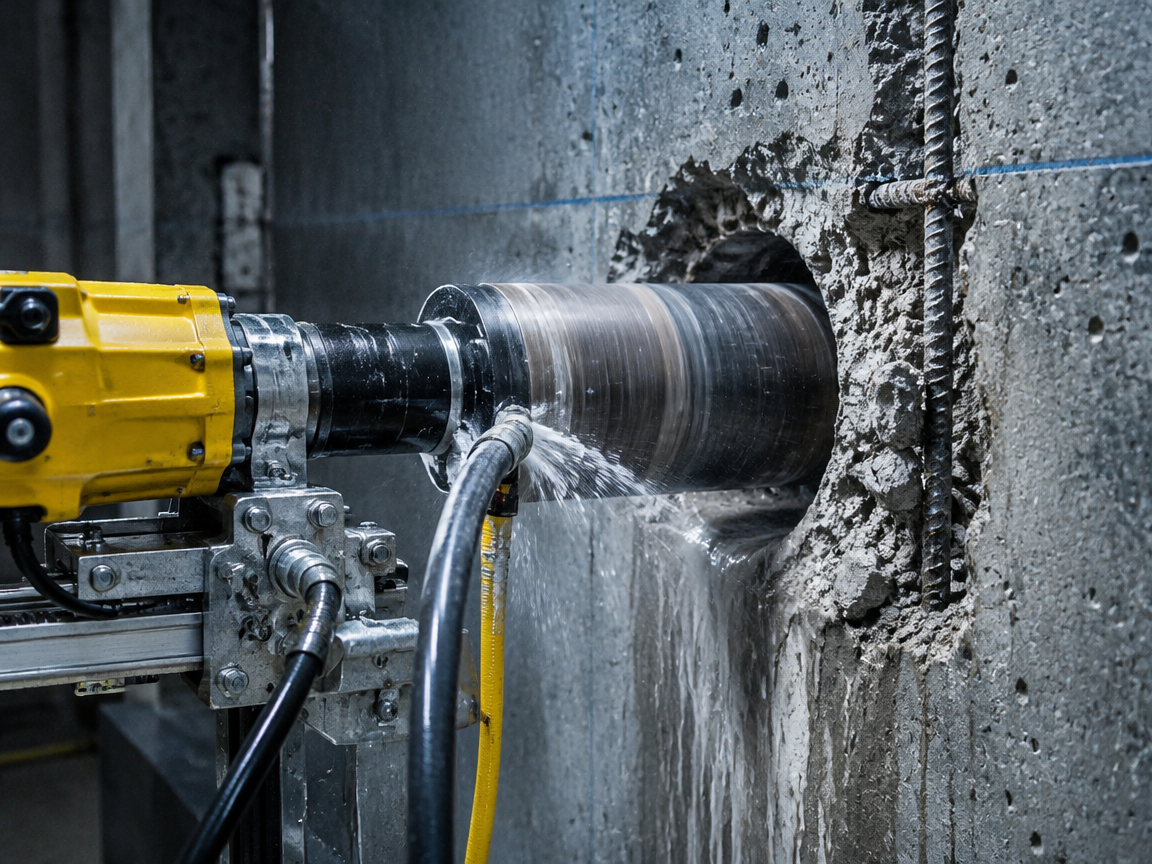
Wall core cutting makes the openings a building’s services need to travel sideways: a drainage pipe leaving a shaft, cables passing into a plant room, an extract duct through an external wall. Walls are cut with a machine anchored to the wall face, so the hole is drilled horizontally and the finish quality of both faces counts. This page covers where wall core cutting is used, what we check before a wall is opened, and what affects the price.
Service specifications
Typical diameters
25 mm to 350 mm
Walls cut
Reinforced concrete, plain concrete, block and brick masonry
Wall thickness
100 mm to 450 mm (thicker on request)
Method
Wall-anchored diamond core drilling, water-cooled
Coverage
Karachi — availability confirmed per project
Wall core cutting explained
A core drilling machine is fixed to the wall with an anchor and a stand, then the bit is fed into the wall face under controlled pressure. Drilling horizontally needs a firm fixing and a rigid stand — otherwise the bit drifts off the marked position and the hole is no longer round or level.
The same equipment handles concrete and masonry, but the tooling and the feed pressure change. Reinforced concrete needs a diamond segment suited to hard aggregate and steel; block and brick masonry are softer and can be cut faster, but the material is more likely to chip around the edge, so the hole position and finish have to be judged accordingly.
Wall cutting is often the visible part of the job. A penetration through an external wall, a lift lobby wall or a finished partition is seen by everyone who passes it, so the hole is cut true to the marking, the edges are kept as clean as the wall allows, and the core is removed without levering at the surrounding surface.
Typical wall openings
- Plumbing and waste pipes through internal and external walls, including shafts
- Water supply and firefighting pipe routes through concrete walls
- Electrical conduit, cable and busbar openings into plant rooms, panels and risers
- Ventilation, extract and fresh-air openings for kitchens, basements and utility rooms
- Split air-conditioning pipe holes, with the correct fall for condensate drainage
- Gas, water-tank and pump-room line penetrations where the opening is approved
- Service shafts and duct routes in commercial, industrial and residential buildings
What we consider before a wall is cut
Four things decide the method on any wall: the thickness of the wall, the material it is built from, the diameter of the opening, and how much access there is to the wall face.
Thickness drives the tooling and the time. Material decides everything else: reinforced concrete walls hold steel bars that have to be considered, block and brick masonry can be cut quickly but will spall at the edges if the drill is forced, and old masonry walls sometimes contain voids or loose fill that change the cutting behaviour completely. Diameter decides whether the hole is cut in one pass or as a ring of overlapping cores. Access — working from scaffolding, from a platform, over a staircase or in a narrow service shaft — decides how long the setup takes before a single hole is cut.
Reinforcement is the one item that can stop the job. A wall carrying a load is not a wall to experiment with. Where the wall is structural, the opening position and size must come from the engineer responsible for the building, and we cut to that specification. Where a bar fouls the marked position, we stop and confirm before continuing.
Structural checks and embedded utilities
Before cutting, we want to know whether the wall is load-bearing, whether it is a shear wall, and what is buried inside it. Electrical conduit, water lines, drainage and gas pipes are frequently embedded or chased into walls, and hitting one during the cut turns a simple hole into a repair job with the floor below out of use.
Where drawings exist, we work from them. Where they do not, we agree the position on site with you, keep clear of the areas you know carry services, and use careful depth control so we know what we are cutting into as the bit progresses. The rule we work to is simple: no wall is opened until the person responsible for the building is satisfied that the opening is safe and the utilities in that wall are identified.
Dust, water and finish protection
Wall cutting is wet work, and it is usually done in a room that is already finished. Water is fed through the bit and drawn away from the wall with a water ring or a collection arrangement, and the floor and nearby surfaces are sheeted before the machine is fixed in place.
Dust control matters just as much when the wall is chased or the hole is trimmed: fine concrete dust settles everywhere and is difficult to remove from a finished interior. We work with water-fed cutting as standard and clean the wall faces, the floor and the surrounds at the end of the cut.
Factors affecting wall core cutting prices
- Diameter of the opening and the number of openings
- Wall thickness and the number of passes needed through the depth
- Wall material — reinforced concrete, plain concrete, block or brick masonry
- Reinforcement or embedded steel encountered in the cut
- Access to the wall face, including scaffolding, working height and shaft entry
- Water and power available at the position, and the size of the machine that fits
- Protection and cleaning needed for finished interiors
- Travel within Karachi and the number of visits required
Wall Core Cutting FAQs
Wall Core Cutting — common questions
If your question is not answered here, call us — the answer usually takes less than a minute.
Can you cut an opening in a load-bearing wall?
Only where the opening has been approved by the structural engineer for the building. The position, the size and any strengthening requirement come from that assessment; we then carry out the cut exactly to the approved specification.
Do you cut block and brick walls as well as concrete?
Yes. Block and brick masonry are cut with the appropriate tooling and a lighter feed, because the material chips easily at the hole edge. Tell us what the wall is built from before the visit and we will bring the right bit.
How do you know where the services are inside the wall?
From your drawings, from what you tell us about the building, and by working carefully and stopping if anything unexpected appears in the cut. Identifying the utilities in a wall before cutting is part of the site check, not something we guess at while drilling.
Can a split AC pipe hole be cut in a finished wall?
Yes, this is a routine job. The hole is drilled with the correct fall for condensate drainage, the wall around it is protected, and the edges are left clean for the installer to sleeve and seal.
Does wall core cutting need scaffolding?
For high positions or walls that cannot be reached from the floor, yes — a working platform or scaffold is needed to fix the machine safely and to keep the cut true. If you cannot provide one, we can include access arrangement in the quotation.
Related services
Other work we carry out
Most projects need more than one type of opening. These are the services that usually go with this one.
Round, accurately placed holes through reinforced concrete walls, slabs and beams — cut with diamond core bits and finished clean.
Vertical holes through floor slabs for drainage, plumbing, conduits and services — cut accurately and cleaned out ready for the pipe.
Holes for fixings, anchors, pipes, conduits and ventilation — drilled to the right diameter and depth in concrete, block and masonry.
Request a quotation
Need wall core cutting priced for your site?
Send the diameter, the quantity, the thickness and the project area in Karachi, Sindh. You will get a written scope and a firm quotation.